The pristine image of a forensic scientist hunched over a microscope, while still iconic, is being rapidly supplemented by high-velocity data streams and neural networks. As we progress through 2026, the “Digital Lab” has shifted from a futuristic concept to a standard operational requirement in the United States criminal justice system. From the FBI’s enhanced biometric databases to local precinct predictive modeling, the marriage of Artificial Intelligence (AI) and Big Data is fundamentally altering the DNA of investigations.
The Convergence of Bytes and Biology
In 2026, the volume of data generated during a criminal investigation is staggering. A single crime scene can yield terabytes of information, ranging from 8K surveillance footage and IoT (Internet of Things) sensor logs to complex genomic sequences. Human analysts, regardless of their expertise, are facing a “data fatigue” wall. This is where AI steps in, utilizing machine learning algorithms to scan for patterns that remain invisible to the human eye.
For students and researchers entering this field, this transition is both a challenge and an opportunity. The shift toward computational forensics has created a surge in demand for specialized academic inquiry. If you are currently navigating this evolving landscape, exploring these modern forensic science research topics can provide a critical roadmap for understanding how digital evidence intersects with traditional investigative methods. Whether it’s the ethics of facial recognition or the precision of AI-driven toxicology, the research possibilities in 2026 are nearly limitless.
Big Data: The New Forensic DNA
Big Data in 2026 isn’t just about the volume of information; it’s about the velocity and variety of evidence. Forensic specialists now utilize “Data Fusion” techniques, which combine disparate sources—such as GPS pings, financial transactions, and social media activity—to create a chronological “digital twin” of a crime.
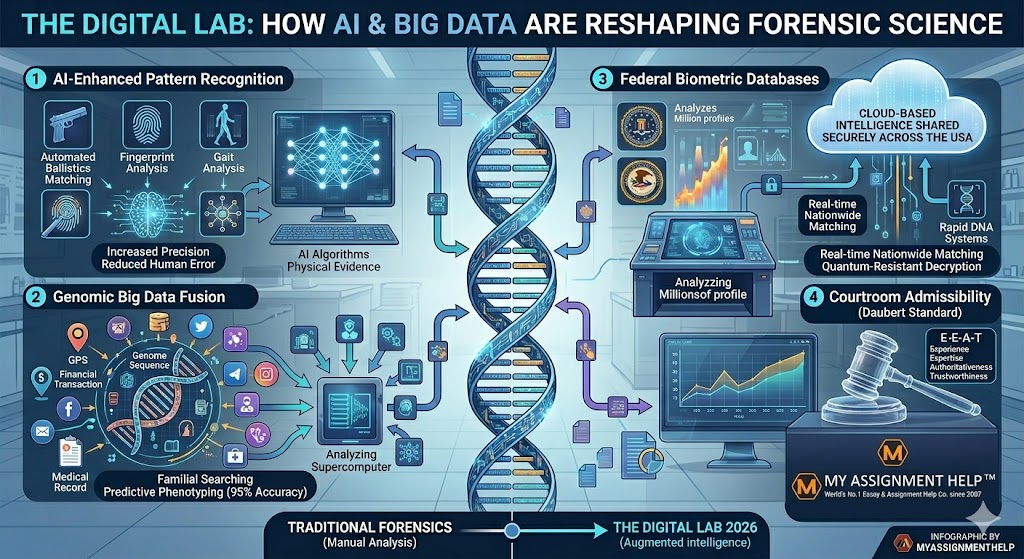
Key Pillars of the 2026 Digital Lab:
- AI-Enhanced Phenotyping: Predictive algorithms can now analyze DNA samples to suggest physical characteristics (eye color, hair texture, ancestry) with 95% accuracy, narrowing down suspect pools significantly.
- Automated Ballistics Identification: Machine learning systems like the upgraded NIBIN (National Integrated Ballistic Information Network) match shell casings across multiple states in seconds—a process that once took weeks.
- Digital Decryption at Scale: With the rise of quantum-resistant encryption, AI-driven pattern-recognition tools are essential for “lawful access” to encrypted devices during federal investigations.
The Educational Hurdle and Professional Support
The complexity of these technologies has set a high bar for the next generation of forensic experts. In US universities—from Texas A&M to George Washington University—forensic science curricula now require a deep understanding of Python, SQL, and database management alongside traditional chemistry and biology.
Many students find that the dual demand of mastering laboratory techniques while simultaneously performing high-level data analysis is overwhelming. This academic pressure has led to a rise in professional collaborative platforms. For those struggling to bridge the gap between complex software simulations and theoretical frameworks, the ability to buy assignment online from specialized academic consultants has become a strategic resource. It allows students to maintain their GPA while focusing on the hands-on, practical lab skills that are indispensable in a 2026 career environment.
Ethical Frameworks and E-E-A-T in Forensics
As we integrate these tools, the principles of E-E-A-T (Experience, Expertise, Authoritativeness, and Trustworthiness) are under more scrutiny than ever. In the US court system, “Black box” AI—where the reasoning behind a conclusion is hidden—is increasingly challenged under the Daubert Standard. Forensic reports in 2026 must be “explainable” to be admissible.
“The goal of AI in forensics isn’t to replace the expert witness, but to provide the witness with a more precise, data-driven foundation for their testimony.” — Journal of Digital Forensic Practice, 2026.
See also: Assistance Support 8666136855 Technofee Com Contact
Key Takeaways
- Precision over Volume: AI reduces human error in microscopic comparisons (ballistics and fingerprints).
- Efficiency: Big Data analytics helps clear the massive “backlog” in US forensic labs by automating initial evidence sorting.
- Predictive Modeling: Data modeling helps departments allocate resources to high-risk areas, though it requires strict ethical oversight to prevent bias.
- Hybrid Skillsets: The 2026 forensic professional must be a scientist and a data analyst in equal measure.
Frequently Asked Questions (FAQ)
1. Is AI evidence currently admissible in US courts?
Yes, provided it meets the Daubert Standard. The methodology must be peer-reviewed, have a known error rate, and be generally accepted within the scientific community.
2. How has Big Data changed DNA profiling?
Big Data allows for “Rapid DNA” testing and familial searching, which can link crime scene samples to distant relatives in genealogy databases.
3. Can AI solve “Cold Cases”?
Absolutely. In 2026, many cold cases are being reopened as AI algorithms re-analyze old evidence against modern, massive databases, finding links that were previously impossible to detect.
4. What programming languages are most useful for forensics?
Python remains the gold standard for data analysis, followed by R for statistical modeling and SQL for database management.
Author Bio
Dr. Aris Thorne is a Senior Content Specialist and Academic Consultant at MyAssignmentHelp. With over 12 years of experience in technical writing and a background in Computational Biology, Dr. Thorne specializes in bridging the gap between emerging technology and educational integrity. He has contributed to numerous journals regarding the ethics of AI in the American education system.
Sources & References
- National Institute of Justice (NIJ) – “The Impact of AI on Forensic Science: 2026 Report.”
- American Academy of Forensic Sciences (AAFS) – Digital & Multimedia Sciences Section updates, 2026.
- Journal of Forensic Sciences – “Machine Learning Applications in DNA Phenotyping” (March 2026).
- U.S. Department of Justice – “Advancing Justice Through DNA Technology and Data Fusion.”